Hard water · Piece
What hard water does inside a boiler
Limescale in a boiler can build up where hard water is heated. Approved Document L tells installers to treat the feed to water heaters and combi hot-water circuits in hard water areas, but it names no device.
Most useful for: Anyone with a combi or cylinder, or about to replace a boiler
Compiled from the sources at the end. Updated .
Figures for how much scale costs in extra gas, or how many years it takes off a boiler, did not come from any official source used here, so none appear. If a sales page quotes a percentage, ask where it came from. What can be stated plainly is the rule that applies when a new appliance goes in, and which water that rule is about.
Where does scale form in a boiler?
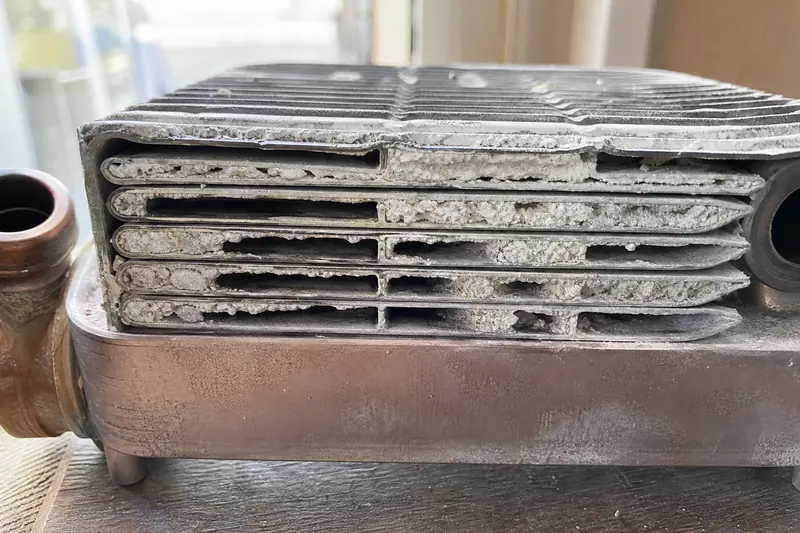
Scale tends to settle where hard water is heated. DWI cites the World Health Organization saying water at 200 mg/l or more produces scale. In a boiler, the likely place is the heat exchanger, where water runs through narrow passages next to the hot metal. As scale builds up, it can restrict flow and make it harder for heat to reach the water.
On a combi, each hot tap sends fresh mains water through the boiler, and in a very hard area each run brings more of the minerals that form scale. With a cylinder, the water heater and its feed are the equivalent place. Combi or cylinder in an older house compares the two. Slow or uneven hot water can have many causes, so scale is something for an engineer to confirm, not assume.
What does Part L ask installers to do?
The guidance in force now is Approved Document L, Volume 1, the 2021 version with 2023 amendments. Its appendix defines hard water as total hardness "greater than 200ppm" CaCO3. Para 8.8 says that before a new heating appliance goes in, circuits should be flushed and inhibitor added. In hard water areas, suitable measures should be taken to treat the feed to water heaters and the hot water circuit of combi boilers to reduce limescale, and the system commissioned to BS 7593.
No specific device is named, so the choice falls to the installer. The 2026 version keeps the 200 ppm definition and moves the paragraph to 7.8. It takes effect on 24 March 2027, with transitional rules, so ask which version covers your job.
Cambridge is above that line on the figures available, as the hardness page explains. Your water company can give the current number for your postcode.
Is inhibitor the same as scale treatment?
No, and the two are easy to confuse. Inhibitor goes into the heating circuit, the water that goes round the boiler and radiators. Scale treatment under para 8.8 is about water on its way to being heated for your taps.
| Circuit | What is in it | What para 8.8 asks |
|---|---|---|
| Heating circuit | Water going round the boiler and radiators | Flush, then add inhibitor |
| Combi hot-water circuit | Mains water drawn for hot taps | In hard water areas, suitable measures to reduce limescale |
| Feed to a water heater | Cold water on its way to being heated | In hard water areas, suitable measures to reduce limescale |
| The finished system | All of the above | Commission to BS 7593 |
So a quote that mentions inhibitor has not necessarily dealt with scale, and the reverse is true too. Old radiators and sludge covers the heating side in older systems.
What can be done about scale already there?
That is a job for a Gas Safe registered engineer, and whether a part can be cleaned or has to be replaced is their call. HSE strongly advises homeowners to have appliances serviced at least annually, though that is advice and not law, and a service is a good moment to ask about scale.
Anything inside a boiler is for a Gas Safe registered engineer. Do not open the casing or try descaling products on a boiler yourself. Checking a Gas Safe engineer shows what to look for on the ID card.
To limit new scale, DWI says softening only the feed to the cylinder or boiler is more economical than softening the whole supply; the softener page sets out what else to weigh in an older house. DWI also says magnetic devices do not soften water, and the page on inhibitors and magnetic devices picks that up.
Questions for the installer
- Which measure are you fitting to reduce limescale on the hot-water side, and why that one?
- Will the circuits be flushed and inhibitor added before the new appliance goes in?
- Will it be commissioned to BS 7593?
- If it is a combi, which extra energy measure from para 6.2 is included?
- Could anything around the old boiler contain asbestos, and how will you handle that?
The last question matters in an older house. HSE's list of places asbestos can be found in a home includes insulating board around a boiler, and it says to tell contractors before they start. Leave any suspect board undisturbed; the asbestos page has more.
Who does which part
- Choosing the scale measure
- The installer; Part L names no device
- Anything inside the boiler
- A Gas Safe registered engineer
- Your current hardness figure
- Your water company
- Notice for a softener on the boiler feed
- Confirm with your water company
Other questions on this
Does a boiler with a cylinder need scale treatment too?
Para 8.8 covers the feed to water heaters as well as the hot water circuit of combis. So in a hard water area, the same question applies when a new heating appliance goes in. Ask the installer what they propose for your layout.
Do I have to add scale treatment to a boiler I am keeping?
Para 8.8 is written around a new heating appliance going in. It does not read as a duty on someone leaving an existing boiler alone. Whether treatment would help that boiler is a question for your engineer.
Does softened water mean no inhibitor is needed?
They treat different water. Softening deals with what comes in for the taps or heater, and para 8.8 asks for inhibitor in the heating circuit regardless.
Sources, read 4 November 2026: Approved Document L, Volume 1 (2021 with 2023 amendments); Approved Document L, Volume 1 (2026); GOV.UK: Approved Document L; Drinking Water Inspectorate: water hardness; HSE: domestic gas safety FAQs; HSE: asbestos diagrams; HSE: asbestos FAQs; TapWater.uk: hardness map (secondary, sells softener quotes).