Old pipes · Piece
Lead pipes in an older Cambridge house
Lead water pipes in UK homes are most likely before 1970, so an older Cambridge house is worth checking. Look at the pipe by the inside stop tap, then ask a plumber or your water company.
Most useful for: Pre-1970 houses, buyers and anyone expecting a baby
Compiled from the sources at the end. Updated .
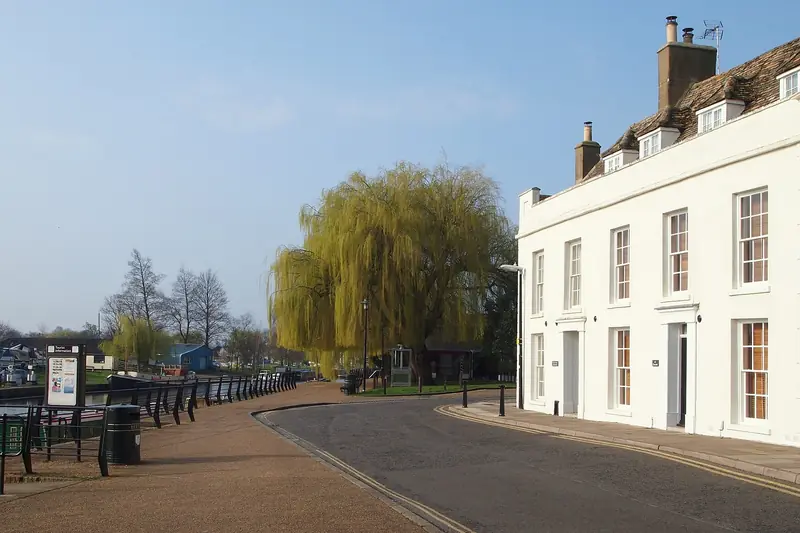
Much of older Cambridge falls on the wrong side of that date. The conservation area appraisal for New Town and Glisson Road describes houses mostly of the 19th or early 20th century, and Newnham Croft's terraces run from the late 19th century to the First World War. Neither document says anything about pipes, so age only tells you to look. New copper in the kitchen tells you little about the length that comes in under the front path.
What does lead look like at the stop tap?
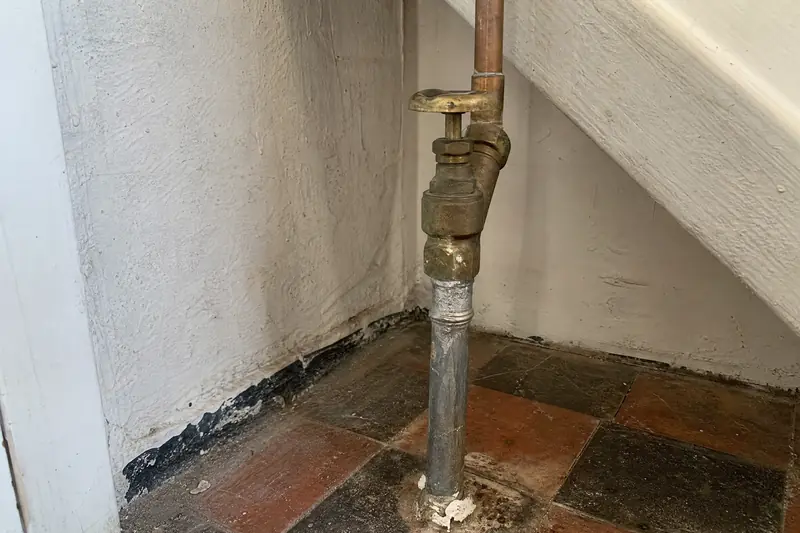
The Drinking Water Inspectorate (DWI) sends householders to the internal stop tap, often under the stairs or the kitchen sink. Unpainted lead is dull grey, and there is often a swollen joint where it meets the tap. A look is enough for a first opinion. Paint, boxing-in and older grey plastic can all confuse it, so have a plumber or the water company confirm what you think you see.
| Material | Colour and shape |
|---|---|
| Lead | Dull grey when unpainted, often with a swollen joint by the tap |
| Copper | Dull brown |
| Iron | Dark, and it may show rust |
| Plastic | Usually blue; older pipe can be grey or black |
Do not cut, drill or otherwise work at an old pipe to find out what it is. Babies, including unborn babies, and children are most at risk from lead, so if someone at home is pregnant or a child lives there, ask for a tap test now and do not wait for building work.
Which length of pipe is yours?
Lead can sit on either side of the boundary, and the DWI splits responsibility at the outside stop valve. Going from the street to the kitchen, the order is: the main; the communication pipe, which belongs to the water company; the outside stop valve; the supply pipe, which belongs to the owner; the inside stop tap; and the pipes in the home, which also belong to the owner.
From the street to the kitchen: who answers for which length
- The main
- Communication pipeWater company
- Outside stop valveWhere responsibility divides
- Supply pipeOwner
- Inside stop tap
- Pipes in the homeOwner
Drinking Water Inspectorate, read 4 November 2026.
So replacing the pipes in the home can leave lead in the ground beyond them. A tenant can raise the point with the landlord as owner. Stop taps and supply pipes covers the wider question of who pays.
Does very hard water make lead less of a worry?
Partly, and only as a possibility. The DWI says harder water forms a protective scale that can reduce lead, and its national map puts the Cambridge area in the top band, with a warning that local figures vary. The same body says more lead can reach the tap when water has stood for longer, when it is warmer in summer and autumn, and when the pipe is in poor condition. Companies also dose orthophosphate where there is a risk.
Softening changes the picture. Softened water may be aggressive to plumbing and leach copper and lead, which matters if you are weighing up a softener in an older house before you know what the pipes are. For the local numbers, see how hard Cambridge water is.
Replacing it: what should you tell the company?
Tell them first. If the communication pipe is lead and at risk of contributing to the problem, the company is legally required to replace it, so notify it when you replace your side. Ask which company that is by checking your bill: Cambridge Water and Anglian Water both serve this region, and who does what explains the split.
A new supply pipe also falls under the fittings rules. Regulation 5 requires notice and consent before certain works, including water laid outside less than 750mm or more than 1350mm deep. A WaterSafe approved plumber can give a work completed certificate, and finding one has its own page.
After any work on a lead pipe, the DWI says to flush for at least 10 minutes. Ask the plumber to confirm that no lead solder went on the drinking water side: it is banned on drinking water pipes but still legal on closed heating circuits.
Who does what about lead
- Say what the pipe is
- A plumber or your water company
- Test the kitchen tap and give written advice
- Your water company, on request
- Replace the communication pipe if lead and at risk
- Your water company
- Replace the supply pipe and pipes in the home
- The property owner
- Check pipes before you buy
- Your surveyor, once asked to mention lead
- Take up an unresolved complaint
- CCW, the consumer body for water
Other questions on this
Can lead come from somewhere other than a lead pipe?
Yes. The DWI says older brass can be a source, and older solder on a drinking water pipe could be another. A house with no lead pipe left can still be worth a tap test if the fittings are old.
What if the pipe by the stop tap has been painted?
The DWI's description is of unpainted lead, so paint takes away the main clue, although a swollen joint may still show. Leave the paint in place and ask a plumber or the company to look.
Should a buyer raise lead before exchange?
The DWI suggests asking your surveyor to check the pipes and to mention lead. Do this early, because the answer may affect which work you plan first.
Is a test result the end of the matter?
No. A result describes the water at that tap at that time, and the DWI's standard for comparison is 10 micrograms per litre. Its long-term answer to lead pipework remains replacement.
Sources, read 4 November 2026: Drinking Water Inspectorate: lead in drinking water; Drinking Water Inspectorate: standards and regulations; Drinking Water Inspectorate: water hardness; Drinking Water Inspectorate: hardness map; Water Supply (Water Fittings) Regulations 1999, regulation 5; WaterSafe: about the register; WaterSafe: lead-free solder; CCW: water companies; New Town and Glisson Road conservation area appraisal; Newnham Croft conservation area appraisal.